
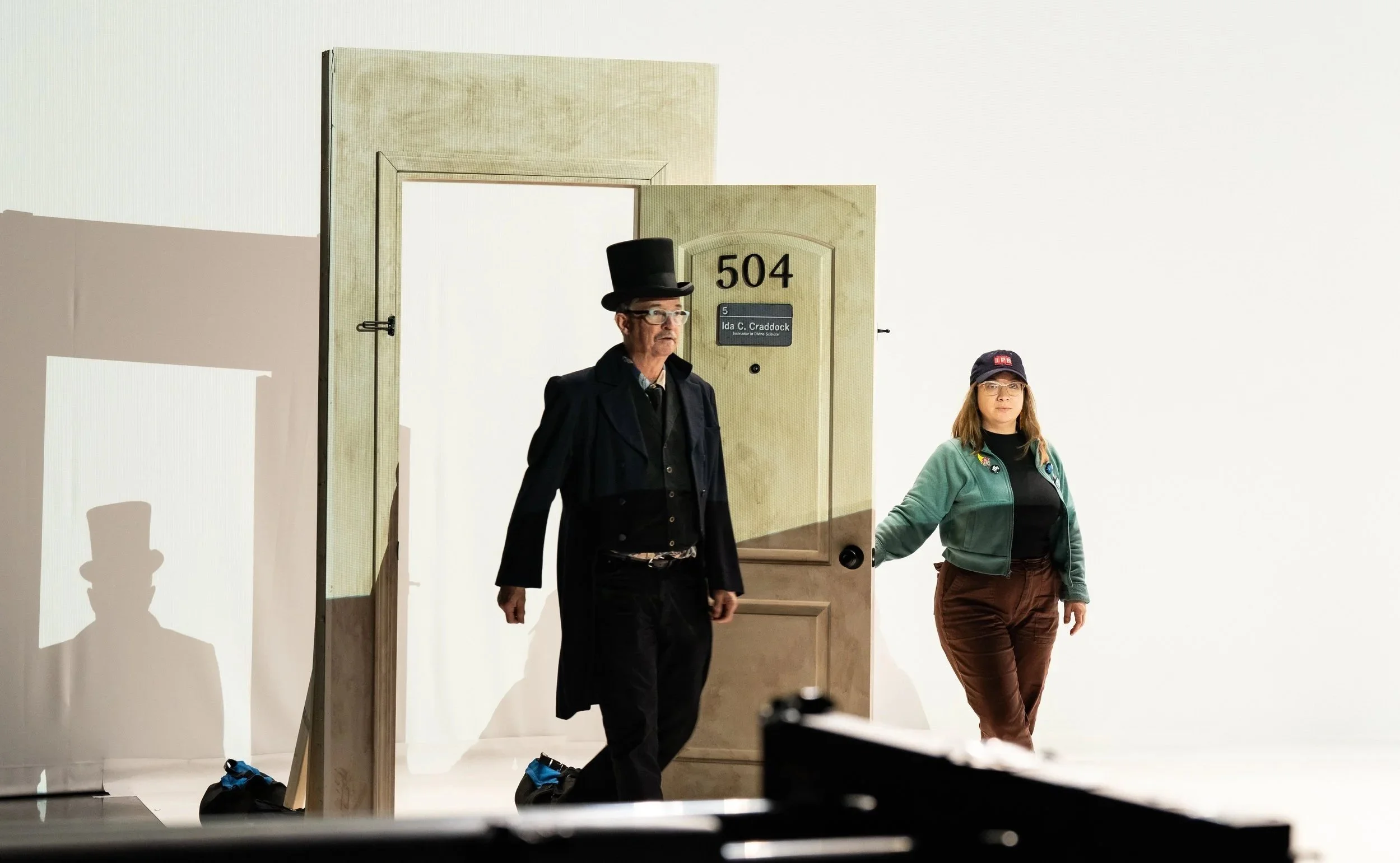
Rehearsing a Victorian silhouette scene for Sex Radical. (Photo by Dylan Chen).
Complete Press Kit is available at bit.ly/sexradicalpk
Press photos are available at bit.ly/sexradicalphotos
Short Video Clips available at bit.ly/sexradicalclips.
Audio Clips available at bit.ly/sexradicalaudio.
Poster available at bit.ly/sexradicalposter
Director Interview at bit.ly/SXRInterview
Complete Press Kit is available at bit.ly/sexradicalpk
Interview with Director Andy Kirshner
by Chelsea Gibson for Nursing Clio (complete interview available at bit.ly/SXRInterview)
How did you first learn about Ida Craddock? Why did you want to make a movie about her?
I just happened to hear a radio interview with the historian, Leigh Eric Schmidt, who wrote a biography of Ida Craddock. This was in about 2008 or 2009. I picked up the book, and her story really moved me. And there were also so many great details to her story: the fact that her first confrontation with Comstock was over a belly-dance at the World’s Fair, that she had a “spirit husband,” that she was a scholar of “phallic antiquities.” But ultimately what interested me most about the story were the striking similarities between the “culture wars” of the 1890’s and the “culture wars” of today: battles over sexuality, gender, free expression, the separation of Church and State. I found it remarkable that America had been having many of the same arguments for 150 years, and that Comstock said things like “Liberals are the heralds of Satan.” So familiar!
You set out to make a documentary-drama about Craddock. Why did you choose that form to tell her story?
Believe it or not, I originally thought it would make a great musical, or maybe an opera. My background is in music and experimental theatre, and at the time I first heard Craddock’s story, I hadn’t yet made a feature film. But after exploring the musical idea for a while, I kind of reached a dead end. I put the project aside for many years, and made my first two feature films. The second one, 10 Questions for Henry Ford, was also a documentary-drama, and I found that using that form enabled me to lay out the historical background and social context of the story while still retaining the emotional core of the drama. The film could be an emotional and an analytical/reflective experience at the same time. That’s always what I’m after.
Anthony Comstock is a familiar figure to anyone who studies US history. What was it like casting him? What part of his story were you hoping to portray?
Well, he has such a signature look. The mutton-chop side-whiskers, the ill-fitting suit revealing his paunch, the scar on his face. He really is a kind of opera buffa character – to go back to the musical idea. In some ways he was ridiculous and laughable, but he was also cruel. He damaged so many people’s lives through his monomaniacal pursuit of “obscenity.” Like so many Christian Nationalists today, he thought himself to be a “soldier of the Cross,” someone on a holy mission that justified just about any kind of violence, cruelty, or dishonesty. So on the one hand, I needed someone who physically resembled Comstock, someone who had a big booming voice and could take up a lot of space – someone who could be both ridiculous and dangerous. Joey Albright does a terrific job of playing him in the film, and our hair and makeup artist, Linda Long, found a way to work the requisite side-whiskers. Emily Sutton-Smith, who plays Ida Craddock, and Joey, who plays Comstock, were already friends after previously playing husband and wife. So, I think that brought an intimacy to their interaction in the film that made it all the more engaging to watch. Comstock’s pursuit of Craddock was very personal – it wasn’t just one more arrest for him. He had a score to settle.
Did you begin the process of making this film before the Dobbs decision in 2022? (I would assume so!) How has your relationship to the film, and to Craddock’s story, changed?
Yes, I did start it before Dobbs. And I was very deep into work on the screenplay when the decision came down. It didn’t really change what I wrote (since the film is based on Ida’s actual words), but I did start to think more about the “bodily autonomy” aspects of Craddock’s writing and advocacy. Of course, bodily autonomy and reproductive freedom are woven all through Craddock’s writing about women’s sexuality, but not necessarily as explicitly as it is in the writing of some of her contemporaries. That was one of the reasons that I ultimately added Emma Goldman as the narrator of the film, so those themes could be drawn out a bit more.
Having said that, I never dreamed that the actual Comstock Law from 1873 would be revived in 2025! But as you know, since Dobbs, anti-abortion activists have been calling for renewed enforcement of the abortion-related sections of the law. And there are several lawsuits coming out of places like Texas and Missouri that are ultimately aimed at getting the Comstock Law affirmed by the Supreme Court. They want to use it to ban medication abortion and invalidate shield laws. That would be a convenient way to enact a national ban, without Trump or Congress having to take political heat for enacting a new law. It’s astonishing, and also very sneaky and dishonest. I’m hoping discussion around the film can make people more aware of what’s currently going on around Comstock. Outside of historians and reproductive rights activists, most of the people I talk to have no idea about the Comstock Act and the potential danger it still poses to reproductive freedom.